
Why AI Transformations Fail: The Technology Is Usually Not the Problem
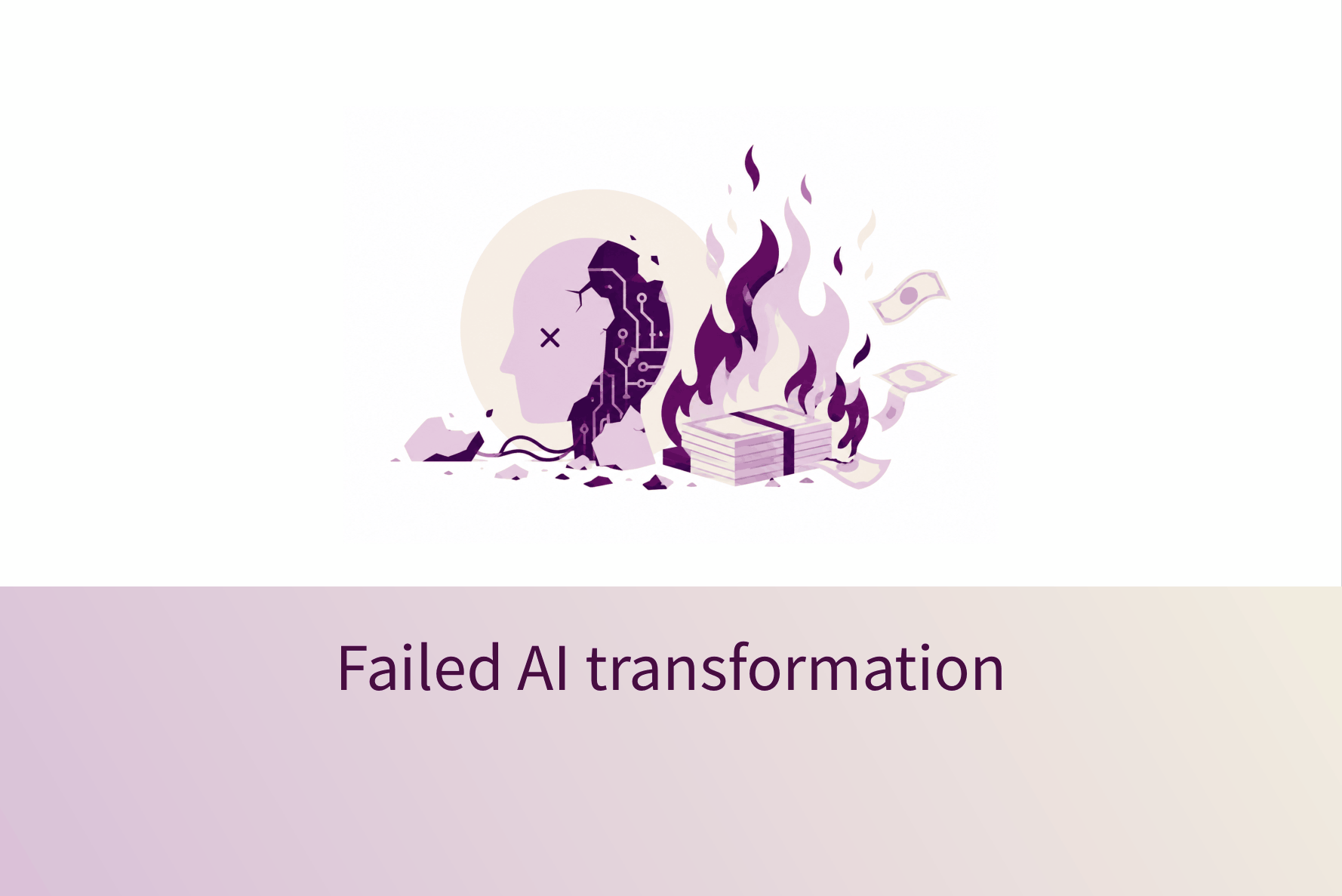
As CEO, you are not investing in AI because the technology is interesting. You are investing because you expect a business result. That may mean higher productivity, lower operating costs, stronger margins, faster execution, better customer experiences, or new revenue opportunities. The business case for AI is ultimately about ROI, profitability, and your company’s ability to remain relevant as customer expectations and competitive dynamics change.
The challenge is that technology alone does not create those outcomes. Your people have to adopt new ways of working, your managers have to reinforce those changes, and your organization has to translate strategy into daily execution. If that does not happen, even a strong AI solution can produce disappointing results. The system may be implemented successfully while the expected business value remains unrealized.
Your AI investment only creates ROI when behaviour changes
Many transformations appear successful at the beginning. The technology is launched, communication is sent, employees complete training, and project milestones are achieved. Yet several months later, usage may still be inconsistent. Some teams embrace the new tools while others quietly continue working as before. Some managers encourage experimentation, while others struggle to explain what the transformation means for their teams.
This gap matters because your financial business case probably assumed that people would actually change how they work. If adoption is weak, productivity gains are delayed, costs remain high, processes stay inefficient, and customer improvements fail to materialize. From a CEO perspective, this is not simply a change-management issue. It is a profitability and execution issue. The key question is therefore not, “Did we implement the technology?” It is, “Is our organization adopting it fast enough to produce the business results we expected?” That distinction changes how transformation should be managed.
Resistance is often a leadership issue, not a technology issue
From the executive level, an AI transformation can look entirely logical. If new technology can automate repetitive work, improve decision-making, and strengthen competitiveness, adoption may seem like the obvious next step. Employees, however, experience change from a different perspective. They may be wondering how their role will change, whether their skills will remain valuable, whether expectations are clear, and whether management is genuinely committed to the new direction.
These concerns do not disappear because the technology works. If they are not addressed, they can create passive resistance, inconsistent usage, and slower execution. Your frontline leaders play a critical role here because they translate strategy into everyday behaviour. They answer questions, reinforce priorities, and influence whether employees see the transformation as something real or simply another corporate initiative. Your learning program is important, but learning alone does not guarantee adoption. Employees may understand how a new AI tool works and still avoid using it. Managers may complete leadership training and still struggle to explain the transformation convincingly. For this reason, you should distinguish between learning, adoption, and business impact. Learning builds knowledge. Adoption changes behaviour. Business impact determines whether that behaviour produces measurable improvements in revenue, cost, productivity, margin, customer value, or strategic capability.
You need earlier visibility into adoption risk
One of the biggest risks in a large transformation is discovering resistance too late. Information becomes filtered as it moves through the organization, and by the time concerns reach the executive team, they may already have affected execution. Traditional project reporting may tell you whether milestones were completed, but it often does not tell you whether frontline leaders understand the strategy, whether employees believe in the change, or where adoption is beginning to slow. That is why transformation adoption should be treated as a leading business indicator. You need to know where managers are struggling, which concerns are appearing repeatedly, and where execution may be at risk before those issues affect customers or financial performance. The objective is not to monitor individuals. It is to identify patterns early enough to act.
For CEOs, the most useful transformation questions are therefore practical and commercial:
- What measurable business result are we expecting from this investment?
- Which behaviours must change for that ROI to materialize?
- How will we know whether frontline leaders genuinely understand and support the transformation?
- How quickly will we identify resistance or execution problems?
- How will we connect adoption data back to profitability, productivity, and customer outcomes?
If those questions cannot be answered clearly, the transformation plan is incomplete.
How Skill Up Leader supports transformation adoption
Skill Up Leader’s Transformation Adoption Program is designed to help close the gap between executive strategy and frontline execution. The program supports frontline leaders with AI-enabled coaching while giving the executive team aggregated insight into transformation readiness, recurring concerns, and potential adoption risks. Instead of treating transformation as a one-time communication or training exercise, Skill Up Leader helps create a continuous feedback loop. Your leaders receive support as they navigate the change, while your executive team gains better visibility into where understanding, confidence, or execution may be breaking down. That makes it easier to adjust communication, leadership support, or implementation priorities before problems become expensive.
This matters because your transformation does not create value when the technology goes live. It creates value when your people use it effectively enough to improve how the business performs. Skill Up Leader helps your company move from strategy to adoption, from adoption to execution, and from execution to measurable business results.
The real transformation is your organization’s ability to adapt
AI is only one part of a much larger shift. Your customers are changing, your competitors are changing, and the pace of technological development will continue to accelerate. The companies that remain relevant will not necessarily be those that buy the most technology. They will be the companies that can repeatedly turn new technology into better customer value and stronger business performance. As CEO, your responsibility is therefore bigger than implementing AI. Your responsibility is to build an organization capable of adapting quickly enough to protect ROI, strengthen profitability, and remain relevant in the future. Technology is the enabler. Adoption is what turns it into value.