
What Should Your Leadership Program Deliver for the Business?
.png)
As CEO, the question is not whether your company should invest in leadership development. It is whether your learning program improves business performance and produces a meaningful return on investment.
Leadership development should strengthen strategy execution, productivity, profitability, retention and future customer relevance. If it cannot be connected to these outcomes, it risks becoming a learning activity rather than a strategic investment. Leadership capability also develops at different levels. Team leaders, business-unit leaders and senior executives need different capabilities because they create value in different ways.
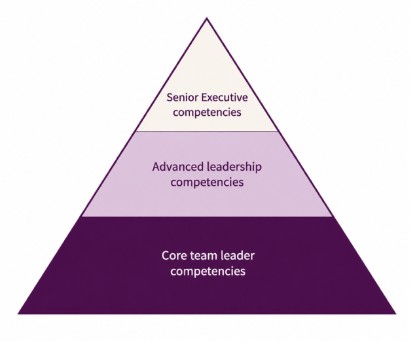
Core team-leader capabilities: improve performance where work gets done
Frontline and team leaders determine whether strategy becomes everyday behavior. Their role is to create clarity, accountability and an environment in which employees can perform. They need strong capabilities in reflection, coaching, feedback, delegation, communication, performance conversations and handling difficult people situations. Practical approaches such as the GROW model can help translate these skills into daily behavior. The business outcome should be stronger teams, higher productivity, better retention and more consistent execution. Development therefore needs to move beyond knowledge and change how leaders actually behave.
Advanced leadership capabilities: turn strategy into execution
As leaders take responsibility for larger functions or business units, their focus expands from team performance to organizational execution. They need stronger capabilities in strategic planning, change leadership, talent development, cross-functional collaboration, resource allocation and decision-making under complexity. The business outcome should be faster strategy execution, stronger transformation capability and more effective use of resources.
Senior executive capabilities: protect today and build tomorrow
At executive level, leadership becomes an enterprise responsibility. Senior leaders need to deliver current financial performance while deciding where the company should compete in the future.
They need enterprise-wide strategic thinking, customer and market orientation, innovation capability, stakeholder communication and sound investment decisions. The business outcome should be profitable growth, stronger competitive positioning and continued relevance to future customers. Executive leadership therefore needs to protect today’s profitability while building tomorrow’s business.
Where Skill Up Leader fits
Skill Up Leader has a specific role within this broader architecture. Its five-week program focuses on strengthening the core leadership capabilities of frontline and team leaders in a short, scalable format. It is intentionally not an executive leadership academy. Its purpose is to strengthen the leadership fundamentals that influence everyday execution across the organization. Employees first provide confidential input on engagement, employee experience and leadership. Team leaders then reflect on themselves, their employees, their team and key stakeholders. Over five weeks, leaders work with an AI coach on real leadership challenges, complete three personalized coaching sessions and practise nine realistic leadership situations. Most importantly, they apply what they learn directly in their daily work. At the end, employees provide feedback again and the executive team receives aggregated insights, recommendations and an analysis of program impact. This connects employee experience, leader action and executive visibility.
The full journey requires around 2.5 hours per participating leader and can be deployed across languages, regions and larger leadership populations. This makes it particularly relevant when your objective is to strengthen core leadership capability quickly and efficiently.
Not every capability gap is a leadership gap
Some leaders need management skills, not more leadership training. Leadership creates direction and trust; management provides the structure to plan, prioritize, allocate resources and deliver results. Your learning architecture should therefore start with the business need: Is the gap leadership, management or both, and how will you know performance improved?
What should you expect as CEO?
You do not need to manage the details of your leadership curriculum, but you should expect your learning function to explain how its investments support the business. It should show which strategic priorities the program supports, which behaviors need to change, where capability gaps exist and how impact will be measured. Completion rates tell you whether training happened. They do not tell you whether the business improved. The right leadership architecture builds core capability at scale, advanced capability where strategic responsibility increases, and executive capability where the future direction of the enterprise is decided.
The key question is not how many people completed leadership training. It is whether your leaders are better equipped to improve performance, execute strategy, protect profitability and keep your company relevant to customers in the future.