
L&D Teams: Why CEOs Should Rethink the Learning Function
It’s no secret—many Learning & Development (L&D) departments are underperforming. According to a McKinsey survey, only 25% of respondents believe training measurably improves performance, while 75% of CEOs are dissatisfied with their L&D teams. (Source: HBR)
For you as a CEO, this is not simply an HR issue. Your learning program consumes budget, employee time, and management attention. If that investment does not improve performance, productivity, profitability, or your company’s ability to stay relevant to customers, the model needs to change.
Why does L&D fail?
The core issue is usually not unmotivated or unqualified L&D employees. More often, it lies in how the function is structured and the mandate it receives. C-level executives, strategy consultants, and CHROs may define the role of L&D with good intentions, but often without a deep understanding of what a modern learning function should deliver. This can limit L&D from the start. But L&D professionals also need to take more responsibility. Many want a seat at the management table, yet often settle for a narrower role focused on courses, administration, and responding to requests. If L&D wants to be treated as strategic, its leaders need the confidence to step forward, challenge the business when needed, take ownership of outcomes, and show why their work matters.
As a result, L&D often struggles to keep pace with the business. Its role is reduced to traditional learning programs and training requests instead of proactively building the capabilities your company needs to execute strategy, improve productivity, adopt new technologies, increase profitability, respond to customer expectations, and prepare for what comes next. In many companies, the team itself also lacks some of the strategic, consulting, and commercial capabilities required to create real business value.
How to Build a Successful L&D Team
Your L&D function should reflect the specific needs of your company, including its size, industry, strategy, workforce, locations, and future capability requirements. But the key question remains the same: Does your L&D function have the mandate and capabilities to create measurable business value?
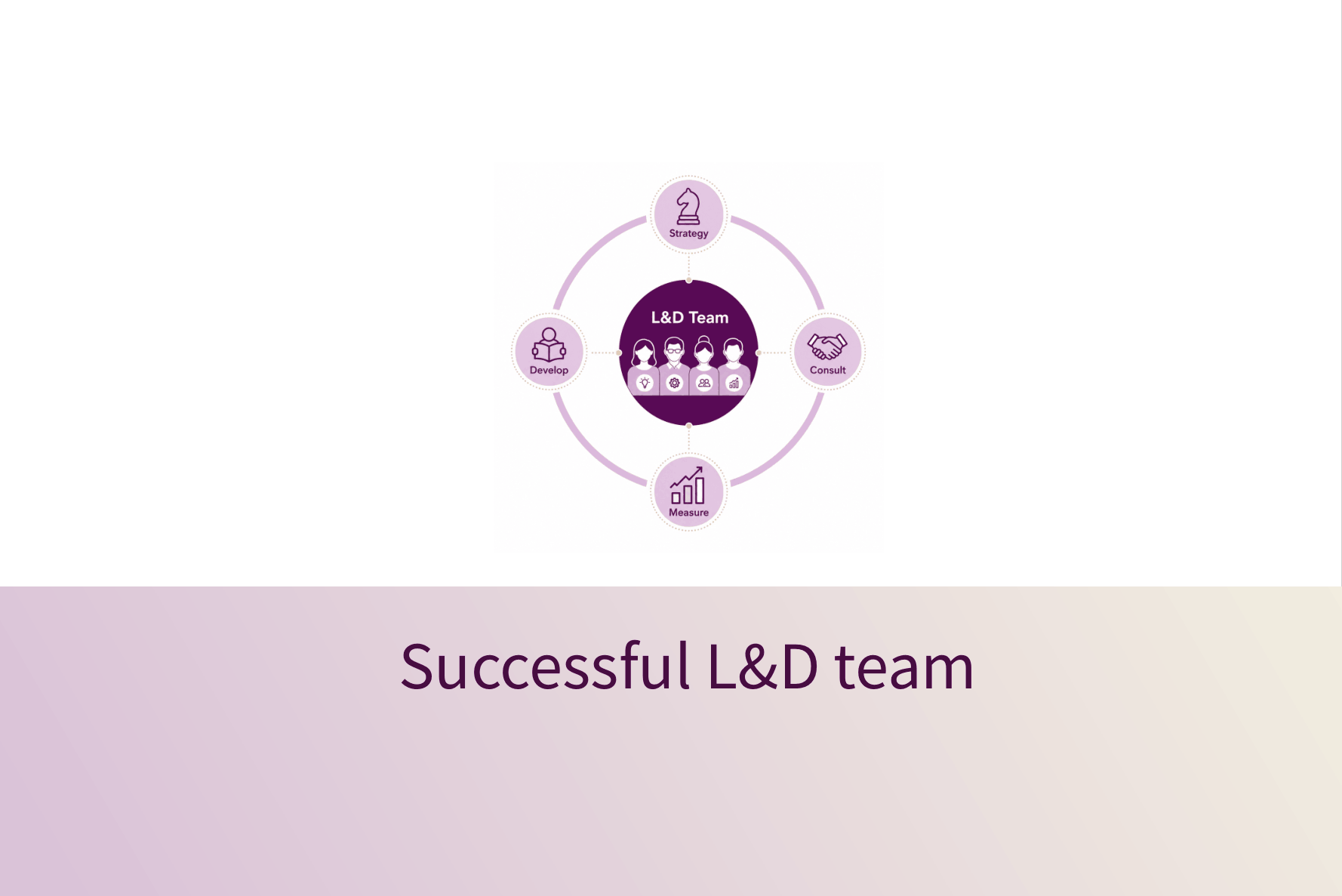
For L&D to succeed, it must move beyond traditional training. Its scope needs to include strategic planning, internal consulting, capability building, performance improvement, and measurement. Only then can your learning program meaningfully contribute to business performance, ROI, profitability, and long-term competitiveness.
Deep Dive: Strategic Tasks
Your L&D team should develop a learning strategy fully aligned with your business strategy and work closely with the CHRO and other relevant HR leaders to embed learning into your employee value proposition. For L&D to become strategic, it needs access to the discussions where strategy is shaped and executed. Your L&D leaders must understand where your company is going, how business units contribute, what drives revenue and profitability, what customers expect today, and which capabilities your organization will need tomorrow. They must also speak the language of management. The conversation needs to move beyond courses, completion rates, and learning hours toward performance, productivity, revenue, costs, customer value, strategic execution, and ROI.
Skills needed: Strategic thinking, stakeholder management, and change management.
Deep Dive: Consultant Tasks
Your L&D team should build strong relationships across the organization and act as an advisor to leadership and middle management. Its role is to understand performance challenges and determine how skills, knowledge, or better access to information can help solve them. This is how L&D moves from “order-taker” to business partner. When a manager asks for training, the first question should not be, “Which course do you need?” It should be: “What business problem are we trying to solve?” The issue may be a skill gap, but it could just as easily be a problem with processes, incentives, leadership, technology, communication, or structure. A strong L&D team understands the difference and recommends learning only when it is actually part of the solution. This consulting mindset is essential if you expect your learning investments to generate a meaningful return.
Skills needed: Strategic thinking, consulting skills, business acumen, and relationship building.
Development Tasks
Your L&D team should take a leading role in how knowledge and capabilities are developed across your company. This includes building your knowledge management strategy, identifying and closing critical skill gaps, supporting the transition toward a skills-based organization, and developing partnerships with the right external providers—particularly those working with AI and other emerging technologies. Learning itself should become more targeted and closely linked to performance. Rather than relying mainly on standardized courses, your company should provide relevant learning paths connected to roles, business requirements, and employee development, combining formal and informal methods with modern learning principles where appropriate. At the same time, L&D needs to make learning part of daily work. That requires strong internal communication and active involvement from managers. A learning culture does not emerge because employees have access to a course library; it develops when learning helps people perform better and management reinforces its importance. The main objective of L&D is not learning for learning’s sake. It is to help employees perform better while building the capabilities your company needs next. Your L&D team should create a scalable, efficient learning ecosystem that reduces time to competence, closes critical skill gaps, accelerates technology adoption, improves productivity, and helps the organization respond faster to market and customer change. The goal is not more learning activity. It is more business impact from the time and money your company invests.
Skills needed: Andragogy and workplace learning, market research, technology integration, organizational development, instructional design, project and program management, marketing and communication, and change management.
Deep Dive: Measuring Tasks
Your L&D team should consolidate learning activities within your HRIS, regularly evaluate the effectiveness of programs, and link learning data to relevant performance and business metrics wherever possible. Most importantly, it needs to demonstrate results and communicate them regularly to management. L&D is often seen as a “nice-to-have” because its business impact is poorly measured. For you as CEO, that should not be enough. Your learning program consumes budget and employee capacity, so you should expect to understand what the company gets in return. Not every initiative can be translated into a precise financial ROI calculation. But L&D should still connect its work to meaningful outcomes such as productivity, sales performance, quality, customer satisfaction, technology adoption, operational efficiency, retention, risk reduction, or profitability. The key question is simple: What changed in the business because people learned and applied something differently?
Answering that requires L&D to invest in data management, measurement, and communication. Results should be shared consistently with senior management so learning investments can be evaluated like other business investments: by the value they create.
How to Get Started
The role of your L&D function is to help your people perform today while preparing your company for tomorrow. But in high-performing L&D teams, learning itself is not the starting point. Strategy and consulting come first. Without these capabilities, L&D remains trapped in a reactive model where even well-designed programs struggle to create meaningful business impact. The mindset therefore needs to shift: Business first. Learning second. For you as CEO, the goal should not be to offer more courses. It should be to build an organization that can develop the capabilities it needs faster than its environment changes. That directly affects your ability to execute strategy, adopt AI and other technologies, improve productivity, protect profitability, respond to competitors, and stay relevant to customers. This change requires both sides. Your leadership team needs to give L&D the mandate to move beyond training administration and become a genuine business performance function. But L&D also needs to claim that responsibility. A seat at the management table is not given simply because learning matters; it is earned by understanding the business, taking ownership of results, challenging assumptions, and showing measurable value. L&D professionals should have more confidence that their work matters. The capabilities of your people directly influence whether your strategy succeeds or fails. That is a significant responsibility—and L&D should be willing to take it on rather than settle for a smaller role.
So the question is not simply: “How much are we investing in learning?” It is: “Is our learning function building the capabilities our company needs to perform, stay profitable, and remain relevant to customers—and can we prove the return?”