
How do we learn?
For you as a CEO, learning is not simply about giving employees access to more information. It is about building knowledge and skills that people can readily access when they need to solve problems, make better decisions, serve customers, and respond to new opportunities. Ultimately, the value of your learning program should show up in business performance: stronger capabilities, better execution, higher productivity, improved profitability, and an organization that remains relevant as customer needs and markets evolve.
Humans acquire knowledge through a two-step process:
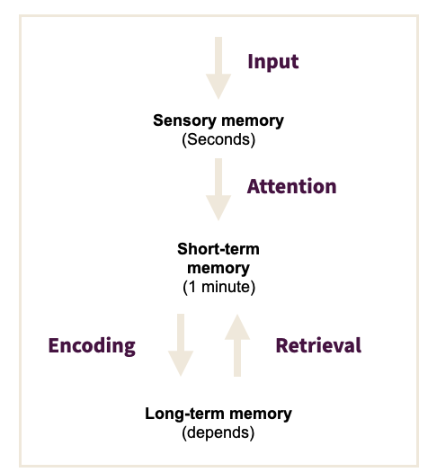
- In the initial stage, information is encoded into short-term memory.
- Storing information in long-term memory involves two interconnected phases: consolidation and retrieval. First, information in short-term memory is consolidated with existing knowledge in long-term memory. During this process, it is reorganized, stabilized into memory traces, given meaning, and linked to past experiences and other knowledge. Next comes retrieval, where information from long-term memory is accessed. Each retrieval not only updates the information but also enables its application when needed.
These stages do not occur automatically. Your learning program needs to activate them intentionally if you want learning investments to translate into changed behavior and measurable business outcomes.
Deep-Dive Phase 1: Encoding
Your employees are constantly surrounded by new information. Throughout the day, their senses take in what they see, hear, and feel, which the brain must process. However, short-term memory has limited capacity and cannot handle an overload of information. So how does the brain decide what to keep and what to ignore? The answer lies in attention. Attention acts as a filter, prioritizing relevant details while ignoring the rest.
Capturing and keeping a learner’s attention depends on connecting the material to their personal interests, challenges, and needs. For your company, this means employees are more likely to engage with learning when they can clearly see why it matters to their role, their performance, their customers, or their future. Attention is often unconsciously guided by what matters most to the learner, whether that is solving an immediate challenge or responding to a future concern. These motivators can range from rational extrinsic factors such as recognition, money, or career progression to emotional intrinsic drivers such as curiosity, purpose, or passion.
From a CEO perspective, this has an important implication: simply making training available does not mean employees will learn.Your learning program needs to answer questions such as:
- Why does this matter to the employee?
- Why does this matter to your company?
- What business problem does this help solve?
- How will this capability help you serve customers better in the future?
Attention is fragile. Maintaining focus is mentally exhausting, even when the content is relevant. That is why your learning programs should avoid overwhelming employees with a flood of information. If learners are not given breaks, they will take them anyway. There is also a common misconception that simplifying learning as much as possible always benefits learners. In reality, removing too much effort can undermine the learning process. Friction and effort are essential for effective learning because they prompt the brain to engage more deeply and process information more thoroughly. Challenges help sustain attention, but they need to be carefully balanced. If the material is too difficult, learners may become frustrated and disengage. The ideal approach is to create a state of flow through didactic reduction: presenting manageable challenges, accompanied by regular opportunities for small wins. This builds confidence and creates a deeper connection to the subject.
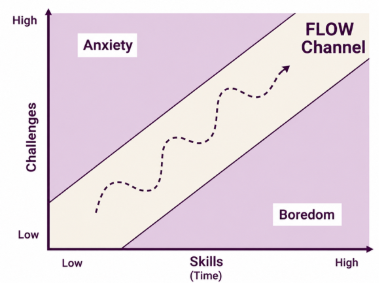
For your company, the objective is not to make learning as easy as possible. It is to make learning effective enough that employees can later perform better when it matters. That distinction has a direct impact on the ROI of your learning investment.
Deep-Dive Phase 2: Consolidation & Retrieval
The consolidation phase of learning plays a crucial role in integrating newly acquired knowledge into long-term memory. During this phase, long-term memory changes. But how?
Neurological studies indicate that the transfer of information from short-term to long-term memory occurs through synaptic consolidation. Essentially, the brain builds new mental frameworks by connecting new information with existing knowledge, as described by constructivist learning theory. This process of sense-making highlights the importance of prior knowledge in learning. The more knowledge a person possesses, the more mental connections they can form. Those connections improve both the stabilization of new information and its long-term retrievability. This matters for your business because organizational capability compounds. The more relevant knowledge and experience your employees build, the easier it becomes for them to understand new developments, adapt to changing customer expectations, adopt new technologies, and make informed decisions. To support learners during the consolidation phase, retrieval plays a crucial role. Your training programs should encourage employees to access information from long-term memory and integrate it with new information from short-term memory.
This process creates additional mental models and reinforces the stabilization of knowledge. Practices that are particularly effective include:
- elaboration,
- transfer into realistic situations,
- social interaction and discussion,
- reflection,
- repeated retrieval, and
- spaced learning over time.
This is why a one-off training event rarely creates sustainable capability on its own. If information stored in long-term memory is not regularly retrieved, the brain tends to forget it as neural pathways weaken and cease to function. You can think of it like training a muscle: the brain relies on reinforcement. Alternatively, imagine a path in fresh snow while new snow falls every day. If the path is not maintained, it gradually disappears. Eventually, you need to recreate it almost from scratch.

The same principle applies to your company’s capabilities. If strategically important knowledge is not applied, discussed, and reinforced, the value of your learning investment erodes over time.
How do we develop skills?
The goal of your learning program should not be to store large amounts of information in employees’ long-term memory. The objective should be to develop skills that allow people to apply that knowledge and create business value. Without transfer into real work, knowledge has limited value. Employees may have completed a course, passed an assessment, or received a certificate, but none of these automatically improve productivity, customer outcomes, revenue, or profitability. So what exactly defines a skill, and how does it differ from knowledge?
A skill is the ability to perform a task effectively and efficiently. While learning information and acquiring skills complement each other, they serve distinct purposes.
- With 100% knowledge but no skill, the employee may understand the theory but cannot apply it effectively in practice.
- With 100% skill but no knowledge, the employee may be able to repeat a familiar task but lack the adaptability required when circumstances, technologies, markets, or customer needs change.
Your company needs both. For optimal effectiveness, your learning strategy should enable employees to develop knowledge and skills simultaneously. This allows your workforce not only to execute today’s tasks effectively but also to adapt as your strategy and customer environment change.