
Awareness Leadership Model: Freeing the CEO to Lead the Future
.png)
As CEO, your role is not to solve every operational problem in your company. Your role is to protect profitability, create sustainable business ROI, make strategic choices and ensure your company remains relevant to customers in the future. But this becomes difficult when too many decisions, people issues and operational challenges continue to move upward. Your middle and lower-level team leaders therefore play a critical role. The better they lead, the less operational complexity reaches senior management.
Your learning program should not only teach management tools. It should develop the awareness required to understand what is happening, recognize what is needed and take purposeful action.
The Awareness Leadership Model
Awareness comes first. Action comes second. Effective leaders learn to notice situations, behaviors, emotions, risks and opportunities before reacting. They then choose a mindful and purposeful response, operating above the line rather than falling into blame, avoidance, defensiveness or automatic behavior.
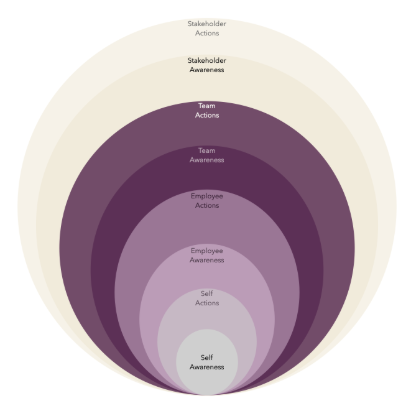
- Manage yourself: Leadership starts with self-awareness. How am I doing right now? What am I feeling, and how is that influencing my behavior? Am I acting intentionally, or simply reacting to the situation? Strong leadership starts with understanding yourself before trying to lead others.
- Manage each employee: Every employee is different. Strong leaders are aware of the person in front of them: What is their character and communication style? How are they feeling? What do they need from me right now? The leader then adapts how they communicate, support, challenge and guide each individual.
- Manage the team: A group of capable individuals does not automatically become a high-performing team. Leaders need to understand the dynamics within the team. What is working well? What is creating friction? What is holding the team back from performing at its best? Awareness of these dynamics allows the leader to take purposeful action to improve collaboration, accountability and performance.
- Manage stakeholders: Leadership also means managing relationships sideways, upward and across the organization. How strong is the relationship with each stakeholder? Where is there trust, tension or misalignment? What can I do to improve the relationship? By becoming more aware of these dynamics and investing in the right relationships, leaders can build trust, increase their influence and get things done more effectively across the organization.
Why This Matters to You as CEO
When leadership capabilities are weak, operational complexity travels upward. Senior leaders become involved in problems that should have been handled two or three organizational levels earlier. When leadership capabilities are strong, the opposite happens.
- Decisions are made closer to the business.
- Employees receive clearer leadership, feedback and accountability.
- Employee engagement increases because people feel seen, supported, involved and clear about what is expected of them.
- Teams take greater ownership and solve more problems independently.
- Collaboration across departments becomes easier.
- Customer needs are recognized and addressed faster.
- Productivity, performance and profitability improve.
- Senior leadership gains more capacity for strategy, innovation and future growth.
Employee engagement is an important part of this. Engaged employees are more likely to contribute ideas, take responsibility, collaborate effectively and put energy into creating value for customers. Better leadership strengthens engagement, ownership and performance, which ultimately supports stronger business results.
Leadership development therefore becomes much more than an HR initiative. It becomes a business investment. The ROI of your learning program should be visible in stronger leaders, more engaged employees, better-performing teams and less operational dependency on senior management.
Turning Awareness Into Successful Leadership Habits
Knowing leadership theory is not enough. Your team leaders need to reflect on how they lead, practise new behaviors in real situations and repeat them until better leadership becomes a habit.
The Skill Up Leader 5-Week Leadership Program offers CEOs a practical way to build this capability across their leadership layers. The program helps team leaders become more aware of themselves, their employees, their teams and their stakeholders, while applying what they learn directly in their daily work. Rather than taking leaders away from the business for long training sessions, the focus is on learning, reflection and practice over time. Team leaders can build stronger habits around self-management, employee leadership, team performance and stakeholder management while continuing to lead their teams. The objective is not simply to complete another leadership course. It is to create lasting behavioral change that improves how leaders think, communicate, make decisions and take responsibility.
For you as CEO, this provides a scalable way to strengthen leadership closer to where the work happens. When your lower and middle leadership layers become more capable and accountable, the organization becomes less dependent on senior management for everyday decisions and problem-solving.
The CEO Outcome
When your team leaders become more aware, they make better decisions, manage people more effectively and take greater ownership of everyday challenges. Over time, these behaviors become habits that strengthen employee engagement, team performance and accountability across the organization. The result is less operational work moving upward. Fewer issues need senior-level intervention, and your leadership layers become more capable of running the business effectively.
That gives you, as CEO, more space to focus on what only you can do: shape strategy, strengthen profitability, create future growth and ensure your company continues to stay relevant to customers. Strong leadership at every level does not just improve the organization. It gives the CEO the capacity to lead the future.